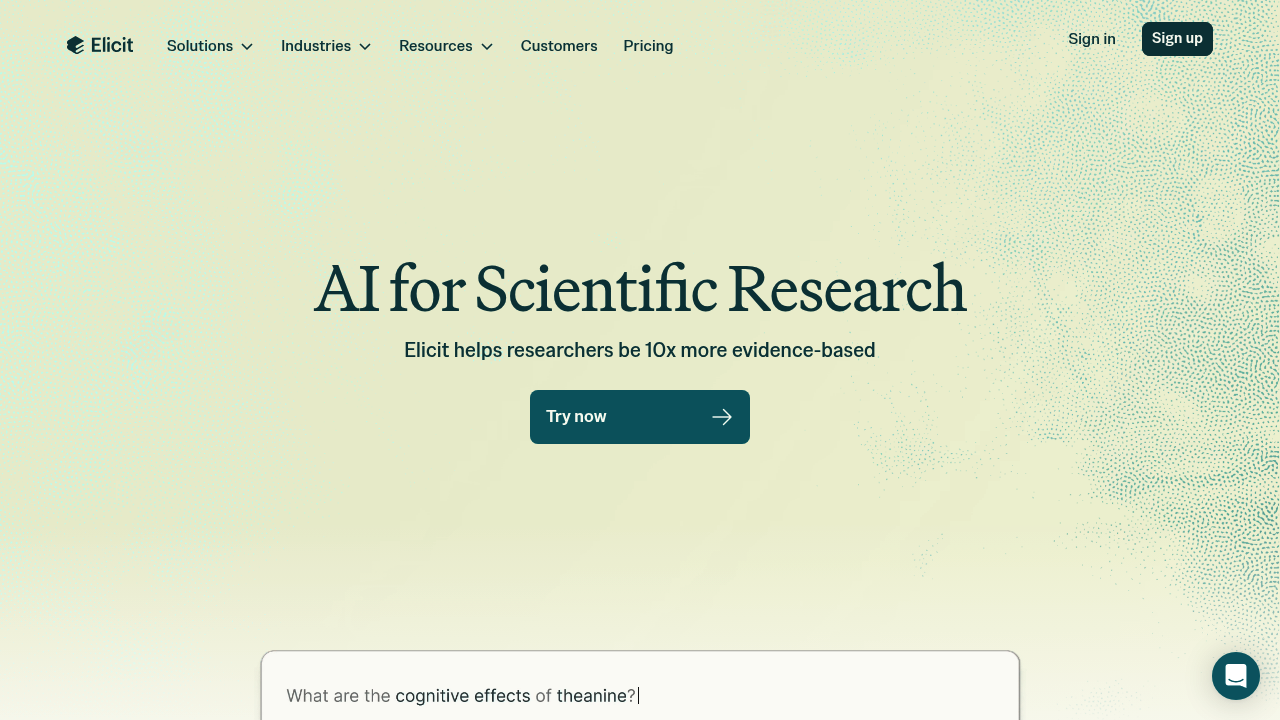
Elicit: AI Research Assistant for Literature Reviews and Paper Summarization (2026)
Elicit is an AI-powered research assistant that automates the most time-consuming parts of academic literature review: finding relevant papers, extracting key findings, and summarizing results across large collections of studies. Covering 138 million+ papers with full-text access, Elicit lets researchers run semantic searches, extract structured data from papers into comparison tables, and generate automated reports — all without the manual reading bottleneck of traditional systematic review. Built by Ought, an AI safety research organization, Elicit is used by researchers, graduate students, and scientific teams who need rigorous, traceable evidence rather than AI hallucinations. It's one of the few AI tools designed specifically for research-grade summarization in 2026.
| Feature | Details |
|---|
| Type | AI Research Assistant / Summarization Tool |
| Best For | Academic researchers, systematic review teams, PhD students |
| Paper Database | 138M+ research papers with semantic search |
| Key Features | Literature search, paper summarization, data extraction tables, automated reports |
| Systematic Reviews | Full systematic review workflow support |
| Data Sources | Elicit database, PubMed, ClinicalTrials.gov |
| Pricing Free | Limited free plan (2 automated reports/month) |
| Pricing Plus | ~$12/user/month (annual) |
| Pricing Pro | ~$49/user/month (annual) |
| Pricing Team | ~$79/user/month (annual) |
| Free Plan | Yes, with significant limits |
| Developer | Ought (AI safety research organization) |
Semantic Search Over 138M+ Papers
Elicit's search goes beyond keyword matching to understand the conceptual meaning of your research question. It finds papers where the findings are relevant even if they don't use your exact terminology — a critical advantage in systematic reviews where exhaustive coverage matters more than precision keyword matching.
Automated Data Extraction and Comparison Tables
One of Elicit's standout features is its ability to extract structured data from papers into comparison tables. Ask "what was the sample size, intervention, and outcome?" across 50 papers and Elicit generates a table — the kind of work that used to take research teams weeks of manual screening. This is particularly powerful for systematic reviews and meta-analyses.
Automated Research Reports
Elicit's Research Agent can generate comprehensive reports on any topic, synthesizing evidence across multiple papers into a structured document with citations. The free plan allows 2 automated reports per month; Plus and Pro unlock higher limits. These reports are a significant accelerator for literature review sections of research papers.
Full-Text Paper Access and Chat
Elicit provides full-text access to papers in its database and allows you to "chat" with papers — asking specific questions and getting answers grounded in the actual text. This is more reliable than generic AI chatbots that hallucinate citations, because Elicit always shows the source passage it's drawing from.
ClinicalTrials.gov and PubMed Integration
For medical and health researchers, Elicit's integration with ClinicalTrials.gov (545,000+ studies) and PubMed adds structured clinical research to the search scope, making it a comprehensive tool for evidence-based medicine workflows.
Known Limitations
- Not a general writing assistant — it summarizes and extracts, but doesn't help you write your paper
- Free plan is quite limited (2 reports/month); heavy users need Plus or Pro
- Coverage varies by field — very strong in biomedical sciences, but may have gaps in humanities or arts
- Automated summaries should still be verified against source papers — AI can misinterpret nuanced findings
- The interface has a learning curve; not as intuitive as consumer writing tools
Best For
- Researchers conducting systematic literature reviews
- PhD students needing to survey a research field quickly
- Medical and health researchers using PubMed and ClinicalTrials.gov data
- Science journalists and evidence-based writers needing reliable paper summaries
- Research teams running meta-analyses who need structured data extraction
Who Should Look Elsewhere
- Writers who need content generation — Elicit doesn't write blog posts or marketing copy
- Students looking for quick essay help — Paperpal or Jenni AI are more suitable
- Teams needing collaborative content workflows — tools like StoryChief or Notion AI are better
Pricing & Cost at Scale
Elicit's free plan includes 2 automated reports/month and unlimited searches. The Plus plan at ~$12/user/month (annual) adds more automated reports and data extraction. Pro at ~$49/user/month and Team at ~$79/user/month unlock the full Research Agent and collaboration features. For research teams, the time saved versus manual systematic review easily justifies the cost — a single literature review that might take 40+ hours manually can be completed in a fraction of that time.
Integrations & Workflow Fit
Elicit is primarily a web-based tool. Researchers typically use it upstream of their writing tools — finding and synthesizing papers in Elicit, then writing their literature review in Word, Google Docs, or Overleaf with tools like Paperpal or Writefull. It fits naturally into academic workflows as the research intelligence layer before drafting begins.
What Users Are Saying
Community threads on r/PhD and r/AskAcademia recommend Elicit as the best AI tool for literature reviews, praising its structured data extraction and citation traceability. Users frequently note it's the only AI they trust for systematic reviews because it shows exactly where each claim comes from, unlike general AI chatbots that hallucinate references.
FAQ
- Is Elicit free?
- Yes, Elicit has a free plan with 2 automated reports/month and unlimited searches. Paid plans start at ~$12/month for Plus.
- How many papers does Elicit cover?
- Elicit covers 138 million+ papers, with additional access to PubMed and ClinicalTrials.gov data.
- Can Elicit write my literature review for me?
- Elicit generates research summaries and extracts key data, but you'll still need to write and interpret the review. It's a research accelerator, not a ghostwriter.
- Is Elicit reliable? Does it hallucinate?
- Elicit is more reliable than general AI chatbots because it always shows source passages. However, you should verify key claims against the original papers.
- Who built Elicit?
- Elicit is built by Ought, an AI safety research organization focused on building AI that supports human reasoning rather than replacing it.
Sources