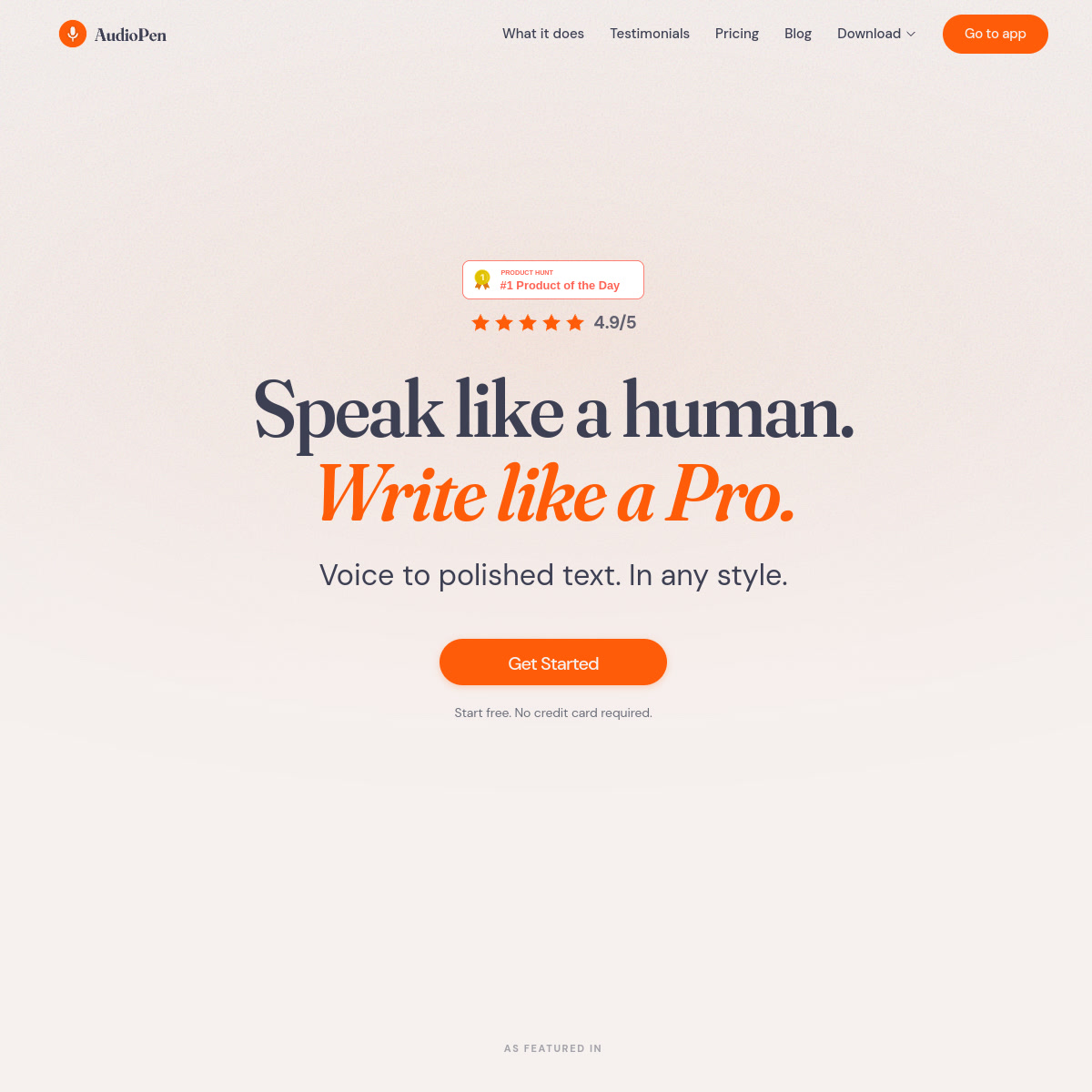
AudioPen: AI speech-to-text summarization tool for Voice notes into clean summaries and written drafts (2026)
AudioPen is a AI speech-to-text summarization tool by AudioPen. Its clearest differentiator is that it focuses on voice notes into clean summaries and written drafts instead of pretending to solve every writing workflow equally well.
Founders, operators, and writers who think out loud and want polished notes or first drafts without typing everything manually.
Skip AudioPen if your main work starts from typed briefs and you need blog or ad templates more than voice capture.
AudioPen: Key Specs at a Glance
| Primary use case | Voice notes into clean summaries and written drafts |
|---|
| Best for | Founders, operators, and writers who think out loud and want polished notes or first drafts without typing everything manually. |
|---|
| AI model | The site says it uses modern transcription models, but the exact model names are not publicly documented |
|---|
| Editor type | Cross-device web and native app workflow centered on voice capture and rewrite |
|---|
| Output types | Summaries, notes, emails, polished drafts, and style-controlled rewrites from speech |
|---|
| Template library | Not positioned as a template-heavy marketing suite |
|---|
| SEO features | None documented |
|---|
| Plagiarism check | Not publicly documented |
|---|
| Grammar check | The rewrite engine polishes text style, but no dedicated grammar product is documented |
|---|
| Integrations | Native apps for iPhone, iPad, Android, Apple Watch, Windows, Mac, and a Chrome extension |
|---|
| Language support | The accessible pages do not publish a full language list |
|---|
| Collaboration | Not publicly documented as a team workspace |
|---|
| Pricing model | Free plan plus paid Prime passes |
|---|
| Free plan | The official schema and page both show a free tier before Prime upgrade. |
|---|
| Paid plans | The official page shows Prime at $33 for 3 months, $99 for 1 year, and $159 for 2 years. |
|---|
What AudioPen Does Well
Excellent for thought-to-draft capture
AudioPen is built around the specific moment when ideas are clearer in speech than on a blank page, which makes it unusually practical for brainstorming, journaling, and rough-article capture.
Cross-device workflow
The official site documents native and extension access across major devices, so a user can capture notes wherever the idea happens instead of being locked to one editor.
Straightforward paid path
The commercial model is easier to forecast than token-based writing apps because the paid choice is primarily about time-based Prime access rather than invisible per-generation spend.
Known Limitations
- AudioPen is best when the input starts as speech, so it is less useful than a classic copywriting suite for structured campaigns, templates, or SEO briefs.
- The accessible pages do not publish a robust team collaboration story, which limits fit for editorial teams working in shared workflows.
- SEO, plagiarism, and source-grounded research features are not part of the visible product story, so it is not a substitute for optimization or academic writing platforms.
- Prime pricing is clear, but the public site does not spell out advanced enterprise controls, governance, or approval flows for larger organizations.
Best For: Who Should Use AudioPen
- Founders, operators, and writers who think out loud and want polished notes or first drafts without typing everything manually.
- It fits knowledge workers, creators, founders, and note-heavy writers who work mainly on summaries, notes, emails, polished drafts, and style-controlled rewrites from speech.
- It works best when the buyer wants a cross-device web and native app workflow centered on voice capture and rewrite rather than a blank generic chatbot.
- It still expects a human editor to verify facts, polish tone, and make final publication decisions.
Who Should Look Elsewhere
- Skip AudioPen if your main work starts from typed briefs and you need blog or ad templates more than voice capture.
- Skip it if you need citations, source retrieval, or academic evidence management inside the editor.
- Skip it if your content team needs multi-user approvals and publishing workflows rather than personal capture and rewrite.
Pricing & Cost at Scale
The official schema and page both show a free tier before Prime upgrade.
The official page shows Prime at $33 for 3 months, $99 for 1 year, and $159 for 2 years.
Prime includes unlimited note storage, and the FAQ says Prime users can upload up to 100 audio files every 4 weeks with a 100MB file limit.
Workflow Fit
AudioPen is strongest when speaking is easier than typing and the user wants a polished text output fast.
Compared with a generic AI writer, this tool makes the most sense when the buyer's main friction matches the use case above instead of needing a universal content studio.
What Users Are Saying
This run searched for community and review links, but the accessible candidates did not validate cleanly with curl from this environment.
- No external community or review URLs validated with curl in this run; rely on the official sources below for product facts.
FAQ
Is there a free plan?
The official schema and page both show a free tier before Prime upgrade.
What does the paid pricing look like?
The official page shows Prime at $33 for 3 months, $99 for 1 year, and $159 for 2 years.
Who gets the most value from this tool?
Founders, operators, and writers who think out loud and want polished notes or first drafts without typing everything manually.
When should you skip it?
Skip AudioPen if your main work starts from typed briefs and you need blog or ad templates more than voice capture.
What is the biggest limitation?
AudioPen is best when the input starts as speech, so it is less useful than a classic copywriting suite for structured campaigns, templates, or SEO briefs.
Sources