Textero: AI Writing Assistant for Essays and Academic Drafts (2026)
Textero is a browser-based AI writing assistant focused on essays, academic drafts, and student writing workflows. Its clearest differentiator is that it combines essay generation with citations, outlining, rewriting, grading-style helpers, and PDF-based academic support rather than acting like a generic chatbot. It is a stronger fit for students, non-native English writers, and people producing structured school papers than for SEO teams or commercial copywriters. If you need search-driven content briefs, brand voice governance, or marketing copy at scale, other AI writing tools will usually fit better.
Textero: Key Specs at a Glance
| Decision area | Textero |
|---|
| Primary use case | Essay drafting, outlining, rewriting, and academic writing assistance |
| Best for | Students, academic writers, and non-native English speakers |
| AI model | Not publicly documented |
| Editor type | Web app with essay drafting tools and academic workflow pages |
| Output types | Essays, outlines, rewrites, summaries, title ideas, and feedback-oriented drafts |
| Template library | Multiple academic sub-tools; total count not publicly documented |
| SEO features | None; the product is academic-writing-first |
| Plagiarism check | Yes, according to the public site |
| Grammar check | Implicit editing support; standalone grammar engine not publicly documented |
| Integrations | PDF upload and document-oriented academic workflows |
| Language support | Not publicly documented |
| Collaboration | Not publicly documented |
| Pricing model | Subscription with several billing cadences |
| Free plan | Free usage options are advertised on-site |
| Paid plans | $19.99/month, $14.99/month billed quarterly ($44.99/quarter), or $8.25/month billed annually ($99/year) |
What Textero Does Well
It is much more workflow-specific than a generic AI essay prompt
Textero does not just promise to write text. The site positions the product around essay drafting, citation handling, outlining, grading-related helpers, rewriting, and academic document support. That makes it easier for students to start from a structured task instead of a blank chat box.
It is useful for users who need guidance, not only generation
The academic angle matters because many student users do not only need words on the page; they need help turning a topic into an outline, clarifying structure, tightening paragraphs, or shortening and improving an essay. Textero covers several of those stages in one ecosystem.
Its annual pricing is competitive for repeat academic use
The annual offer at $99/year, or about $8.25 per month, is cheaper than many broad AI writing suites. That matters for students or individual writers who need a predictable subscription instead of open-ended credit consumption.
It addresses writer confidence and clarity, especially for non-native English speakers
The public positioning leans heavily into helping users reduce writing stress, improve wording, and create more polished academic prose. That makes it attractive to users who need structure and fluency support more than marketing performance metrics.
Known Limitations
- It is tightly focused on essays and academic-style writing, so it is a weaker choice for blog SEO, product marketing, or email campaigns.
- The underlying model and deeper technical limits are not publicly documented, which makes advanced comparison harder for power buyers.
- The public pricing is subscription-based, so even though the annual plan is reasonable, the monthly tier can feel expensive for occasional users.
- Output quality in academic tools still requires review; citations, tone, and factual framing should not be trusted blindly in high-stakes assignments.
- There is little public evidence of team collaboration or editorial governance, so it looks more like a solo-user tool than a managed writing workspace.
- Compared with broader AI writing platforms, it may feel too narrow if you want one product for both academic work and commercial content production.
Best For: Who Should Use Textero
- Students who need help turning a topic into a first draft or workable outline quickly.
- Academic writers who want rewriting, summarizing, and structural support in one place.
- Non-native English speakers who need cleaner phrasing and more confident essay flow.
- Users working under deadline pressure who need a guided writing assistant rather than a blank chatbot prompt.
Who Should Look Elsewhere
- SEO content teams that need briefs, keyword optimization, or SERP-aware content planning.
- Copywriters who mostly produce ads, landing pages, product descriptions, or lifecycle emails.
- Organizations that need strong collaboration controls, editorial review layers, or enterprise governance.
Pricing & Cost at Scale
Textero publicly advertises three paid billing paths: $19.99 per month, $14.99 per month billed quarterly ($44.99 per quarter), and $8.25 per month billed annually ($99 per year). The site also promotes free entry points, which lowers the barrier for users who want to test the workflow before subscribing.
From a cost-at-scale standpoint, Textero is most attractive on the annual plan. For a student or solo academic writer, the annual subscription is easier to justify than the monthly tier if the tool becomes part of a regular coursework routine. For infrequent use, however, paying nearly $20 for a single month can feel high compared with using a general AI assistant ad hoc.
Workflow Fit
Textero fits best when the user needs structure around a school or university writing task: generate an outline, build a first draft, revise sections, shorten or expand text, and improve readability. It is less compelling as a final authority on originality or scholarly accuracy, so the strongest workflow is still human review plus source checking after generation. In other words, it speeds up the drafting phase better than it automates the entire academic writing process safely.
What Users Are Saying
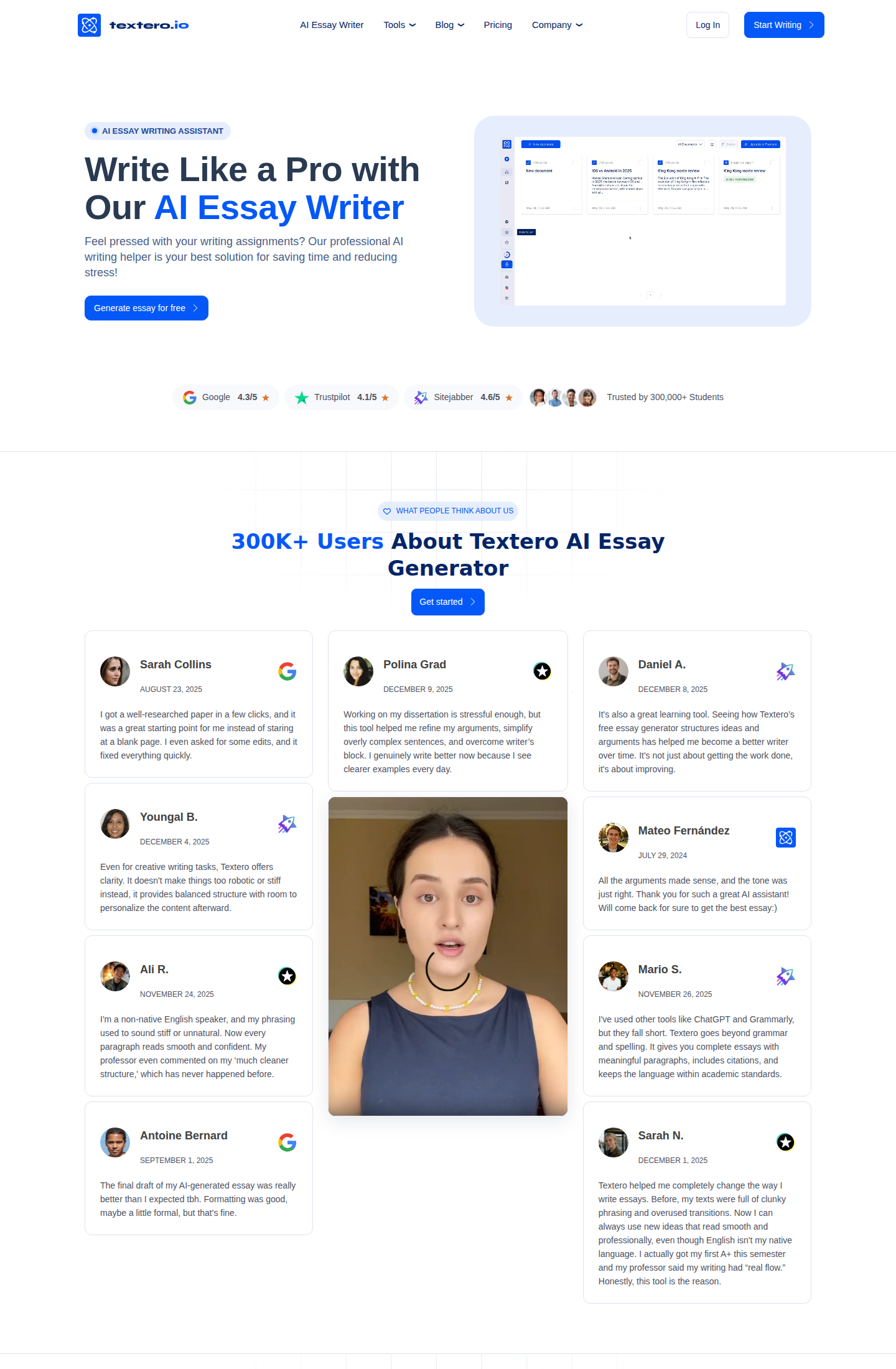
Community links were not reliably validated in this run, so this section uses official sources only. The homepage presents review snippets and student-oriented trust signals, including ratings references and testimonials about clearer academic writing. These are useful for understanding positioning, but they are still vendor-curated rather than independently validated reviews.
Final Verdict
Textero is a good fit for directory 236 because it is unambiguously an AI writing product, but one with a strong academic-writing angle rather than broad commercial content generation. Its value comes from workflow specificity: essays, outlines, rewriting, and citation-oriented assistance for users who need help getting from prompt to structured draft. It is not the best tool for marketers or SEO operators, but it is a credible addition for student and academic writing workflows.
FAQ
Is Textero only for essays?
No, but essays are the core use case. The product also offers outlining, rewriting, summarizing, and feedback-style academic tools around that central workflow.
Is Textero good for students?
Yes, especially for drafting support. The site is clearly positioned around student writing pressure, academic structure, and clearer essay output.
Does Textero have a free option?
Yes. The site advertises free usage entry points, although the full product is monetized through paid subscription tiers.
Should marketers use Textero?
No, usually not. It is built for academic and essay-oriented writing rather than SEO, copywriting, or brand content operations.